


Energy utilities face particular pressure when it comes to workforce planning: the energy transition, digitalization, and demographic change are simultaneously altering skill requirements, succession planning, and cost structures. However, many companies still plan staffing needs, positions, and personnel costs through separate processes. A case study of a municipal utility demonstrates how strategic workforce planning and operational workforce planning can be integrated into a unified approach to achieve greater transparency, reduce coordination efforts, and produce more reliable forecasts.

Why Adopt an Integrated Planning Approach? The Current Situation for Energy Providers
Employee Central provides relevant master data such as job, position, cost center or working time model. But only ECP supplements this picture with the monetary information required for reliable personnel cost planning. The actual payroll results form the basis for a realistic cost model. They reflect collective wage structures, individual remuneration components, variable payments or even complex time models.
This reference to reality significantly changes the quality of planning. Instead of working with flat rates and average values, planning can be based on real salary and wage types. This means, for example, that employer contributions to social insurance, regional differences, collectively agreed step models or bonuses are automatically taken into account in the model. The quality of the forecast increases because the image of the employees in the planning model corresponds precisely to what is also relevant in payroll accounting.
Internationally active companies in particular benefit from this approach. ECP brings global consistency to payroll accounting, while PeoplePLAN offers the possibility of evaluating and planning data uniformly across countries. The result is a common language between HR, Payroll and Controlling – regardless of how many markets or pay scale logics need to be taken into account.
What Operational Workforce Planning Must Achieve for Energy Utilities
The integrated approach has a clear objective: Strategic business goals are directly translated into staffing and resource requirements, and these operational measures are planned at the employee level—not merely as FTE averages across cost centers. Sound strategic workforce planning serves as the foundation upon which operational cost planning is built.
The fact that strategic and operational workforce planning are often still handled separately in practice is evident from the current situation described for many utilities: different data sources, manual reconciliations, and separate planning systems.
That sounds ambitious, but it can be achieved with the right approach. The key elements:
- A unified database comprising HR master data (SAP and other HR systems) as well as organizational management and positions.
- Planning at the employee level (often referred to as “employee-specific”): Hires, terminations, FTE changes, compensation adjustments—all at the individual level.
- Scenario Planning: Multiple planning scenarios in parallel, e.g., budget planning and quarterly forecasts.
- Seamless transfer of the final scenarios to corporate planning in Controlling.
- Integrated reporting at the click of a button, without manual data preparation.
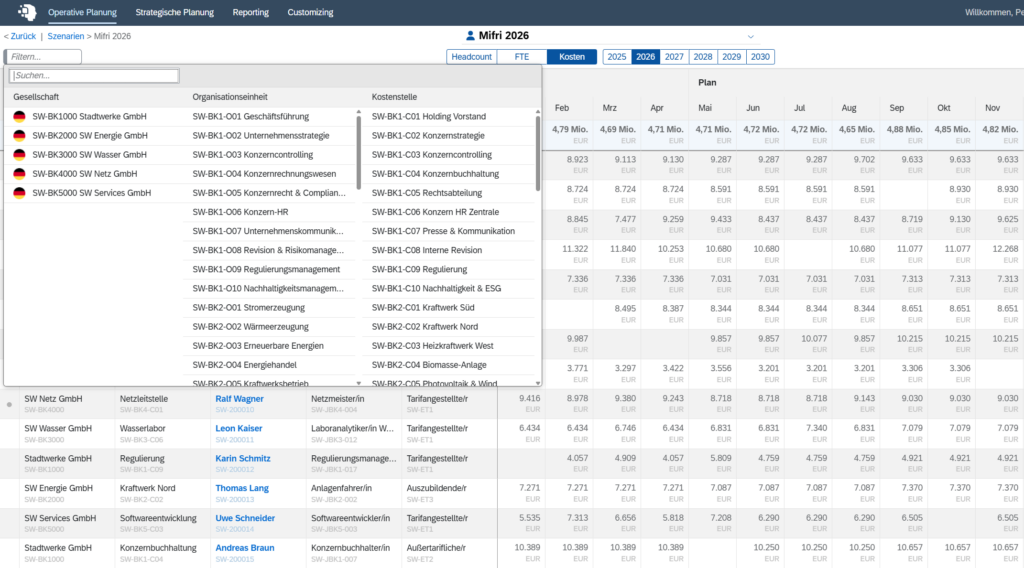
Operational Workforce Planning for Energy Utilities: Employee-Specific Rather Than Flat-Rate
At the heart of the integrated approach is employee-specific personnel cost planning. Instead of using flat-rate averages, each employee is budgeted based on their actual cost components: base salary, allowances, overtime, bonuses, and all social security contributions—including the contribution assessment ceilings.
Typical Planning Horizon for Energy Utilities
For municipal utilities, a five-year planning horizon (medium-term planning) has proven effective, supplemented by detailed budget planning for Year 1 and quarterly forecasts. This allows both long-term workforce strategy and short-term management to be mapped within a single system. The 2024/25 Energy Labor Market Report by Callidus Energie highlights just how much demographic change and the shortage of skilled workers are already straining recruitment planning in the industry—another argument for a multi-year planning horizon.
How Measures Can Be Reflected in Planning
In the planning tool, HR managers can see all of the company’s employees at a glance—organized by organizational units and cost centers. Actions can be recorded for each employee:
- Record an Enrollment or Withdrawal
- Change FTE
- Extend a contract or enroll in a partial-retirement program
- Change Base Rate
- Perform a transfer
All changes are directly and in real time projected onto the personnel costs for the respective scenario. At the end of the process, the Controlling department receives aggregated planning data —in compliance with data protection regulations and without the need for time-consuming manual exports.
Motion Analysis: Changes at a Glance
Transparency regarding planning changes between two cycles is particularly relevant for HR and Controlling: A transaction analysis shows whether variances result from employee departures, compensation changes, FTE adjustments, or other factors. This not only reveals the new planned figure but also its cause.
From Planning to Reporting: Consistent KPIs for Management
Frequently Questions about Operational Personnel Cost Planning for energy utilities
What is meant by operational workforce planning?
Operational workforce planning involves the detailed, employee-specific planning of all personnel costs—that is, salaries, allowances, social security contributions, and special payments—for a defined planning period. It combines strategic personnel planning with budgeting and controlling.
Why is workforce cost planning particularly complex for energy providers?
Energy utilities often have multiple subsidiaries and various business units comprising several companies (energy, water, grid, services), a workforce subject to collective bargaining agreements with different pay grades, a high demand for skilled workers, and planning horizons of up to five years. Standard solutions quickly reach their limits in this context.
What alternatives to Excel are there for personnel cost planning? Excel may be sufficient for smaller, less complex planning scenarios.
As soon as multiple companies, decentralized planning, data protection requirements, or regular forecasts come into play, the workload and the likelihood of errors increase significantly. In such cases, a specialized SaaS solution like PeoplePLAN—which integrates directly with HR master data from SAP or other systems—is recommended.
How long does it take to implement an integrated personnel cost planning system?
That depends on the data set and the system requirements. With PeoplePLAN, many customers are up and running within a few weeks, since the solution is available immediately as SaaS
What Requirements an Integrated Planning Solution Should Meet
The system used in the case study described here is PeoplePLAN by CubeServ. It integrates HR master data from SAP and other HR systems with a powerful planning and reporting interface.
Key system features:
- Consolidating HR data: Master data, organizational management, and positions from SAP and other HR systems are consolidated into a single planning platform.
- Planning measures at the employee level: Hires, terminations, FTE changes, or pay adjustments can be modeled directly in the scenario.
- Centrally manage planning assumptions: Wage increases, social security contributions, and contribution assessment ceilings are stored in a standardized manner.
- Smoothly Transferring Scenarios: Finalized planning scenarios can be forwarded to Controlling or Corporate Planning.
- Derive reports directly from the planning process: KPIs and analyses are generated without any additional manual processing.
Depending on the initial situation, such solutions be implemented relatively quickly and made available via a browser for different roles
Lessons Learned and Pitfalls: What You Should Take Away from Real-World Experience
The implementation at a municipal utility has shown that the path to integrated workforce planning is worthwhile, but it requires proper preparation. The key takeaways:
What effects the integrated approach has had:
- Starting with operational planning at the employee level quickly delivers tangible value.
- Motion analysis has significantly improved communication between HR and Controlling.
- Scenario planning made it possible, for the first time, to compare different wage trends.
What are some typical obstacles to implementation:
- Data quality comes first: Planning is only as good as the master data. A clean data foundation is essential.
- Don’t underestimate change management: Planners in the various departments must be involved early on.
- Clear separation of roles: Who maintains the premises? Who approves the scenarios? These questions must be clarified before go-live.
- Strategic level as a second step: Start with operational planning and expand to the strategic level in a second step.
Conclusion: Operational workforce planning for energy providers pays off
The greatest benefit of integrated workforce planning lies not only in better metrics, but also in greater control. When strategic objectives, operational measures, and reporting come together, the result is greater clarity, faster coordination, and more robust decisions—especially in an environment as dynamic as the energy industry.
Would you like to explore how strategic and operational workforce planning can be integrated within your company?
We would be happy to show you, in a no-obligation consultation, what an integrated planning process for energy providers might look like.
Try it for free | Request a consultation
Or simply give us a call: +49 6142 210 1717 (Germany) | +41 55 224 30 03 (Switzerland)
Frequently Questions about Operational Personnel Cost Planning for energy utilities
What is meant by operational workforce planning?
Operational workforce planning involves the detailed, employee-specific planning of all personnel costs—that is, salaries, allowances, social security contributions, and special payments—for a defined planning period. It combines strategic personnel planning with budgeting and controlling.
Why is workforce cost planning particularly complex for energy providers?
Energy utilities often have multiple subsidiaries and various business units comprising several companies (energy, water, grid, services), a workforce subject to collective bargaining agreements with different pay grades, a high demand for skilled workers, and planning horizons of up to five years. Standard solutions quickly reach their limits in this context.
What alternatives to Excel are there for personnel cost planning? Excel may be sufficient for smaller, less complex planning scenarios.
As soon as multiple companies, decentralized planning, data protection requirements, or regular forecasts come into play, the workload and the likelihood of errors increase significantly. In such cases, a specialized SaaS solution like PeoplePLAN—which integrates directly with HR master data from SAP or other systems—is recommended.
How long does it take to implement an integrated personnel cost planning system?
That depends on the data set and the system requirements. With PeoplePLAN, many customers are up and running within a few weeks, since the solution is available immediately as SaaS

Take advantage of our consulting service and make an appointment with our experts for strategic personnel planning, operational workforce planning and integrated reporting. We look forward to hearing from you.