


The Pay Transparency Act (EntgTranspG) brings more pay transparency to German companies. The new EU Pay Transparency Directive from 2026 will increase the requirements for data evaluation and reporting. How can companies meet the requirements efficiently? And how does PeoplePLAN provide targeted support with implementation?

What is the Pay Transparency Act?
The Pay Transparency Act obliges companies to ensure equal pay between women and men. Employees are entitled to information about the average salary of colleagues of the opposite sex in comparable positions. The aim is to reduce the gender pay gap and prevent discrimination.
The new requirements from 2026
The EU Pay Transparency Directive imposes additional obligations on companies with 100 or more employees:
- Regular pay analyses: Companies must prove that comparable activities are also remunerated comparably.
- Extended reporting obligations: Annual publication of reports on equal pay and remuneration structures.
- Active information: Employees must be regularly informed about their rights.
- Stricter controls: Violations can lead to fines and claims for damages.
The biggest challenge: data evaluation and reporting
Many companies are faced with the question: How can large volumes of salary data be analyzed efficiently and the required reports created in a legally compliant manner?
This is where PeoplePLAN comes in – with powerful functions for HR teams:
1. Automated data evaluation
- Fast data analysis: PeoplePLAN makes it possible to filter and analyze salary data by gender, position, department or location.
- Create comparison groups: The software supports the definition of comparison groups and checks whether the same or equivalent work is remunerated equally.
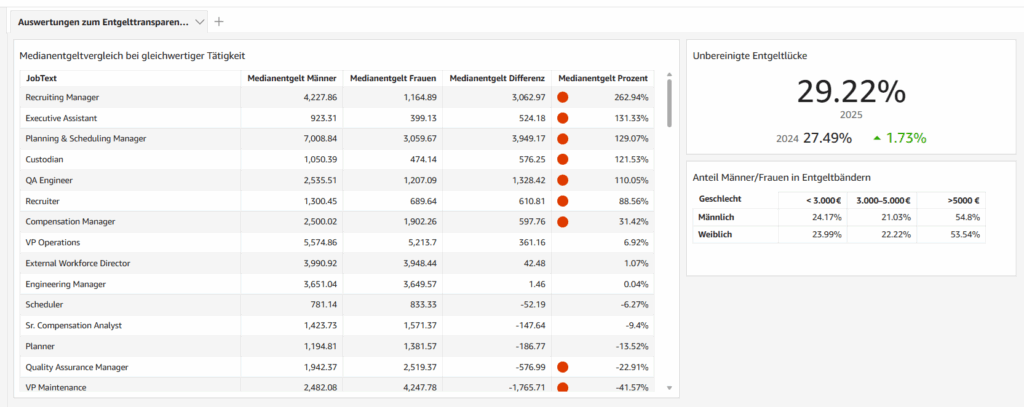
- Recognize anomalies: Clear dashboards make possible differences in remuneration immediately visible.
2. Efficient reporting
- Reports at the touch of a button: All relevant information for statutory reports is compiled automatically and can be exported directly.
- Legally compliant documentation: The reports meet the legal requirements and are archived in an audit-proof manner.
- Individual evaluations: In addition to the standard reports, individual analyses can also be created for internal purposes or for the works council.
Practical example: Relaxed through the audit with PeoplePLAN
A medium-sized company with 350 employees needs to carry out a pay analysis and prepare a report for the management and the works council. With PeoplePLAN, all relevant salary data is transferred from the HR system, automatically evaluated and clearly presented. The HR department can generate the legally required report with just a few clicks and has an overview of the remuneration structure in the company at all times.
FAQ: Frequently asked questions about data analysis and reporting
What data must be evaluated for the Pay Transparency Act?
All relevant salary data by gender, position and peer group.
How often do reports need to be created?
With the EU directive annually – PeoplePLAN automatically reminds you of deadlines.
What happens if irregularities are discovered?
PeoplePLAN indicates anomalies so that companies can react early and derive measures.
Conclusion: On the safe side with PeoplePLAN
The requirements for data evaluation and reporting have been significantly tightened by the Pay Transparency Act and the EU Directive. With PeoplePLAN, companies maintain an overview, save time and meet all legal requirements efficiently and in a legally compliant manner.
Find out more now and request a live demo – experience how easy salary transparency can be!
Further information on the Pay Transparency Act:
- Federal Ministry of Education, Family Affairs, Senior Citizens and Youth:
Entgtelttransparenzgesetz

Take advantage of our consulting service and make an appointment with our experts for strategic personnel planning, operational workforce planning and integrated reporting. We look forward to hearing from you.